The move that decides whether Monday morning arrives with residue or with room.
Welcome to The Relationship Code. This is where I go deeper than a 60 second post can. One relational pattern, pulled apart to the code underneath it, every Sunday. Influence, attraction, and presence. At work and at home.
Sunday night. 7pm. You walk through the door.
You've been on a single rail for nine hours. Strategy. Decisions. Execution. Your brain has been narrowed to one line all day, and that's how it stayed sharp.
Your partner has been on diffuse awareness since the school run. Kids. Dog. Shopping. The temperature of the room. The mood of every person who's walked through it.
Two operating systems. Same kitchen.
You've walked in on a translation problem.
Alison Armstrong calls this single focus versus diffuse awareness. The biological wiring is real. Hormones set the defaults. Testosterone-heavy brains narrow. Oestrogen-heavy brains broaden. That's the textbook version.
Here's the reframe that makes this actually useful for a leader.
Single focus and diffuse awareness are not genders. They are modes.
A female CEO on quarterly close is on single focus. Her partner on kids duty since 4pm is on diffuse awareness. A male founder on a run of investor meetings is on single focus. His partner running the household is on diffuse awareness. Swap it any way you like. The mode is the mode.
David Deida named this in 1997. Masculine consciousness runs single-pointed. Feminine consciousness runs multi-radiant. Either mode, in any body, on any day.
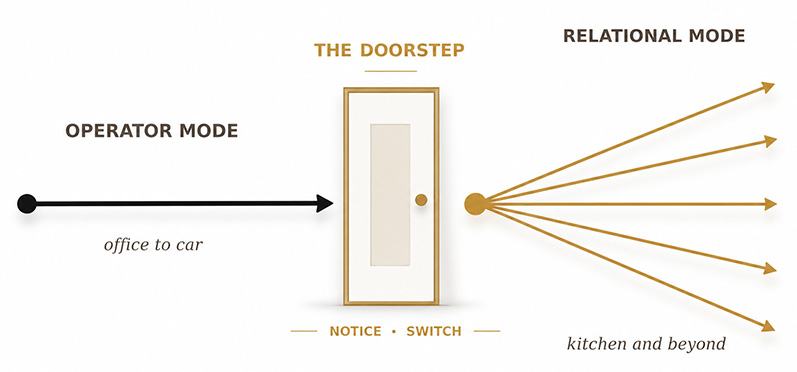
Two modes. One threshold. Different operating systems on either side.
John Gottman has spent four decades studying couples in his Love Lab at the University of Washington. The single strongest predictor of whether a relationship lasts ten years is what he calls turning towards bids.
A bid is any small reach for connection. A look. A comment about the news. A hand on the shoulder as you pass. Couples heading for divorce turned towards each other's bids thirty three per cent of the time. Couples that stayed together turned towards eighty six per cent of the time.
Percentage of partner bids turned towards, tracked across years.
Here's the translation problem. When you're on a single rail, you don't see the bid. They reached. You didn't notice. Repeat that for six months and they stop reaching. You wonder where the warmth went.
The residue rides with you into Monday morning.
Klein and Boals, Journal of Experimental Psychology, showed that unresolved emotional processing takes a measurable bite out of working memory the next day. The friction you didn't translate on Sunday night is the bandwidth you're missing on Monday morning. Every intrusive thought is a background process eating your RAM.
This isn't a couples-therapy problem. It's a bandwidth problem.
The move happens before the door opens.
FRAMEWORK
The Doorstep
One move. Done between the office and kitchen. two beats.
Notice. Which mode am I in right now? Which mode is the person on the other side of that door in? Ask before you walk through it. Most leaders skip this step. Almost nobody is in the same mode as the person they're about to meet.
Switch. Whatever your commute is, use it. Two minutes of breath in the car. A song you only play between work and home. A phrase you say to yourself at the doorstep. Process what the day left in you. Then set it down. You're telling your nervous system: we're changing modes now.
Not a protocol. One switch, on the threshold.
The doorstep is not just the doorstep.
Board meeting at 9am on Monday. You've been on relational mode with the kids since 6am. Use the drive in to switch. Two minutes of breath. A phrase. By the time you sit down at the table, you're on operator mode. Not when you speak. Before.
Difficult conversation with a direct report at 3pm. You've just come out of an hour of narrow, tactical, single-focus work. If you walk into that conversation on the same rail you left the last meeting on, you will miss every bid they make. Switch first.
Same skill. Same threshold. Every door is a doorstep.
The Takeaway Code
In a nutshell. Forty years of Gottman data say the same thing. What keeps a relationship warm is how often you turn towards the small bids. And you can't turn towards what you can't see. Single focus makes the bids invisible. The doorstep is where you change modes, before the room does it for you.
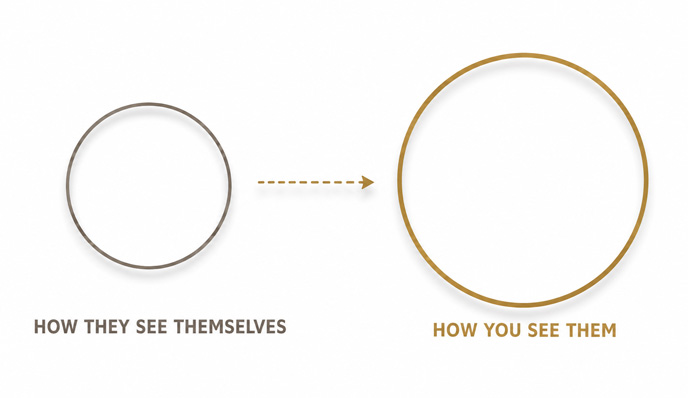
The move. Pick your next mode transition this week. Work to home. Home to work. One meeting to the next. Do the switch on the threshold, not in the room. Two beats. Notice which mode you're in. Switch before you enter. Watch what the next person you meet does with the version of you that walks in.
One switch, on the threshold. Watch the whole night change.
YOUR TURN
What would you want pulled apart next? Hit reply and tell me. I read every one.
Until the next code. Different scene, another pattern pulled apart.
Championing your success,
Anna Garcia
and the Coach HQ Team
SOURCES
Armstrong (2013), The Queen's Code, single focus and diffuse awareness as biological defaults · Deida (1997), The Way of the Superior Man, masculine as single-pointed and feminine as multi-radiant, in any body · Gottman (1994), Why Marriages Succeed or Fail, the first four minutes of a hard conversation as ninety six per cent predictive · Gottman & Levenson (1992), Journal of Personality and Social Psychology, physiological flooding in marital conflict · Gottman & Driver (2005), coding system for daily bids, eighty six per cent vs thirty three per cent turning towards · Klein & Boals (2001), Journal of Experimental Psychology: General, intrusive thinking and working memory capacity.
SATURDAY 1 AUGUST • APPLICATIONS OPEN
The Relationship code • Live
A one-day immersive, online. The frameworks I usually only run with private clients, in the room with you. Where the newsletter goes an inch deep, the Live goes a mile.
"Peace at home is the infrastructure of leadership."
As a reader of The Relationship Code you've been shortlisted. Applications are now open, and spaces are limited.
👉🏼 Book a Consultation 👈🏼
Relevant posts
Subscribe to Our Blog
Related Posts
The Future Self Letter (Issue 10)
The Handbreak (Issue 11)